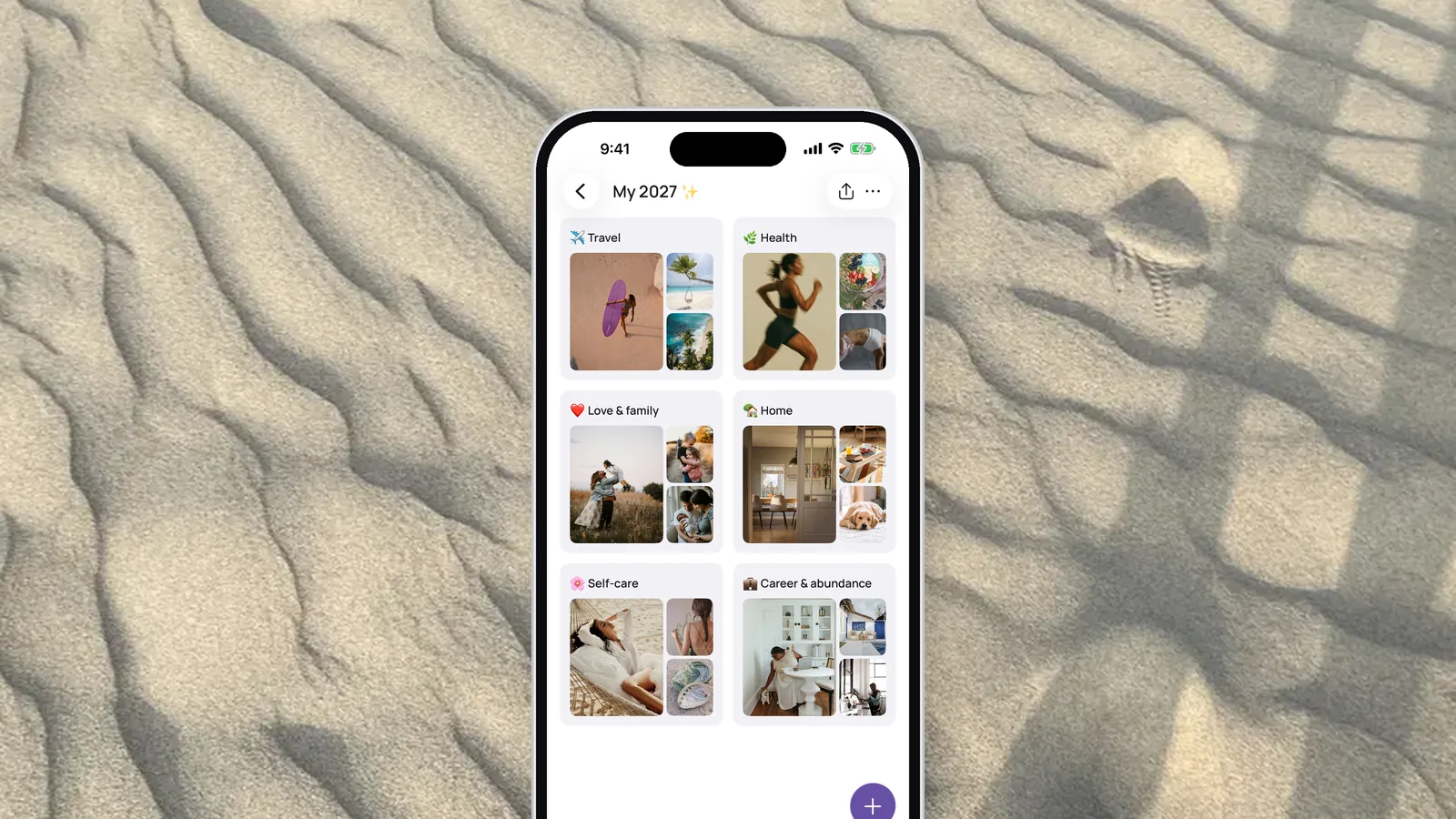
Vision Board
Vision Board Goals: Examples for Every Life Area
Vision board goal examples for all eight life areas, from health and money to love and spirituality. Each one comes with a picture idea and an affirmation, plus a free Wheel of Life printable to score your areas first.
On this page
- What life areas go on a vision board?
- How do you choose goals for your vision board?
- What are some good vision board goals for each life area?
- Health
- Finances
- Business and career
- Family and friends
- Love and relationships
- Personal growth
- Fun and recreation
- Spirituality
- How do you turn a vague wish into a vision board goal?
- How do you turn a goal into a picture?
- Which vision board template should you start with?
I've made vision boards since my teens and have been building VISIYA since 2022. People rarely get stuck on the pictures. They get stuck on the list: what do I actually want this year? Below are vision board goal examples for all eight life areas, each with a picture idea and an affirmation.
What life areas go on a vision board?
Most of life fits into eight areas, and our free Wheel of Balance Board uses exactly these:
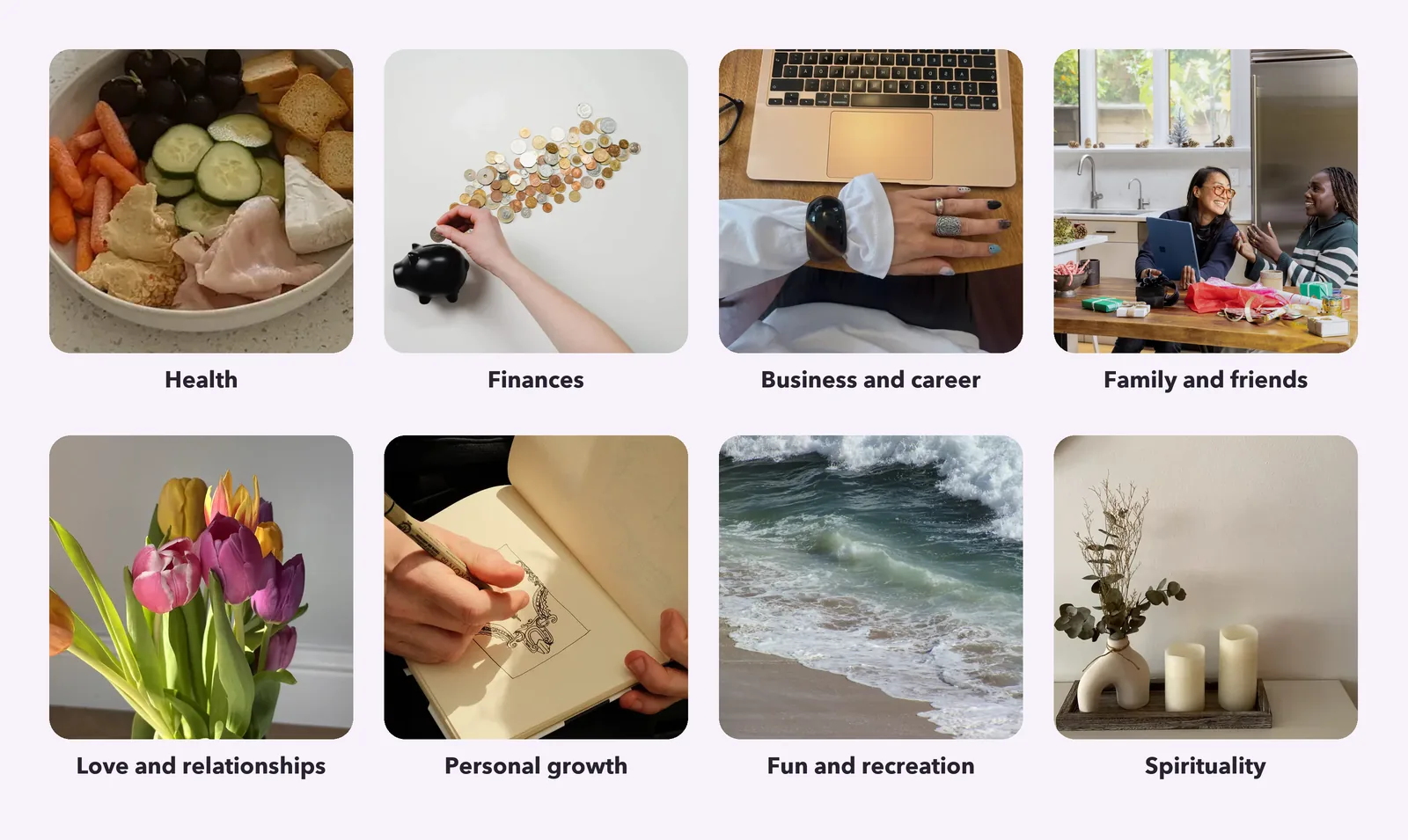
Health, Finances, Business and career, Family and friends, Love and relationships, Personal growth, Fun and recreation, Spirituality.
You don't need all eight. Pick the three or four where you most want things to change this year.
Home or community can be a ninth area. If one goal is all you can think about, like travel, give it a themed board of its own.
One rule: the goals have to be yours. Not your mom's, your partner's or your Instagram feed's.
How do you choose goals for your vision board?
Start with your values, then score each life area from 1 to 10. The areas with the lowest scores are where your board's goals come from.
Before I write a single goal, I write down my six personal values. Each one is a full sentence, not a one-word label like "honesty."
They work like a compass: a goal that fits none of them stays off the board. A couple of my values turned out to be inherited from family or work, so I dropped them.
- Print the free Wheel of Life printable, a circle with eight segments (PDF, no email needed).
- Give each area a score from 1 (not happy at all) to 10 (exactly how you want it). Go with your gut.
- Circle the three or four areas with the lowest scores.
- Write up to three goals for each, like the examples below.
- Fill your board, either in the app or on the Wheel of Balance printable, a one-page PDF with a box for each area (it's A4, so choose "Fit to page" to print it on letter paper).
The wheel groups a few areas differently from the board. More on scoring in our post on the Wheel of Life.
What are some good vision board goals for each life area?
Good board goals have a number or a date. Give each one a picture and a line about how it will feel, and swap in your own numbers.
Health
Ask how you want to feel in your body first. The number comes second.
| Goal | Picture idea | Affirmation |
|---|---|---|
| Run the Turkey Trot 5K on Thanksgiving morning | your race bib | "I'm proud of what my legs can do." |
| Lights out by 10:30 on weeknights, starting in January | a phone charging in the kitchen | "I wake up rested." |
| Book my annual physical before my birthday | an appointment card on the fridge | "I take good care of myself." |
For a training year, the Fitness Vision Board is a VISIYA Plus template.
Finances
Money is private, but it still needs a number.
| Goal | Picture idea | Affirmation |
|---|---|---|
| $1,000 starter emergency fund by March 31 | a mason jar labeled "just in case" | "I have a cushion, and it's growing." |
| Pay off the $2,400 on my credit card by December | a statement showing $0.00 | "I spend money I actually have." |
| Raise my 401(k) contribution to get the full employer match, or open a Roth IRA, by April | a sapling in a pot | "Future me is grateful." |
More in our guide to the money vision board.
Business and career
Ask what's really behind the goal. A promotion is often about recognition or freedom, and there may be a faster way to get those.
| Goal | Picture idea | Affirmation |
|---|---|---|
| Ask for a raise at my April review | a notepad with three wins | "My work is worth asking for." |
| First three paying customers for my side business by July | a packed shipping box | "People are happy to pay for what I make." |
| Pass my certification exam by October | the certificate in a frame | "I'm good at learning hard things." |
The Career Vision Board is a VISIYA Plus template for this area.
Family and friends
One year my board said "new friendships." They never came, but the friendships I already had got closer.
| Goal | Picture idea | Affirmation |
|---|---|---|
| Host Thanksgiving for the first time | a long table with mismatched chairs | "My home is open to the people I love." |
| FaceTime Grandma every Sunday | a phone propped on a mug | "I show up for my people." |
| A girls' weekend with my college friends by Labor Day | the group chat's packing list | "I make real time for my friends." |
Love and relationships
Whether you're single or have been married for years, write down what you want to experience. What your partner should change doesn't belong on your board.
| Goal | Picture idea | Affirmation |
|---|---|---|
| Date night twice a month, on the shared calendar | two menus on a restaurant table | "We still choose each other." |
| A road trip down Highway 1 for our anniversary in September | the coast through a car window | "We make memories on purpose." |
| Single? Try one new thing a month, like a run club | a blank name tag | "I'm open to meeting someone good for me." |
The free Vision Board for Couples is one you fill in together.
Personal growth
Pick something you'd learn just because you're curious.
| Goal | Picture idea | Affirmation |
|---|---|---|
| Read 24 books this year | your library card on a stack of books | "I make time for my own mind." |
| Take a Spanish class at the community college this fall | a sticky note in Spanish on the mirror | "I'm allowed to be a beginner." |
| Journal three mornings a week | an open notebook next to your coffee | "My thoughts are worth writing down." |
Fun and recreation
Usually the first area people cut, and the fastest one to check off.
| Goal | Picture idea | Affirmation |
|---|---|---|
| Use all my PTO, with a week in a national park | a trail sign in Zion | "Rest is part of the plan." |
| A pottery class this spring | a lopsided handmade mug | "I get to make things just for fun." |
| One live concert every season | a ticket stub | "I say yes to what lights me up." |
For a travel year, the Travel Bucket List is a VISIYA Plus template.
Spirituality
Whatever steadies you when life gets loud, from prayer to a phone-free walk.
| Goal | Picture idea | Affirmation |
|---|---|---|
| Ten quiet minutes with my coffee before I check my phone | a mug on a windowsill at sunrise | "I start the day with myself." |
| A worship service or a sound bath once a month | candles in a dim room | "I make room for something bigger than me." |
| Three things I'm grateful for, every night | a journal on the nightstand | "I notice what's already good." |
How do you turn a vague wish into a vision board goal?
Make it specific, put a date on it and phrase it as what you want, not what you want to stop. Then add how you want to feel when you get there.
| Vague wish | Board goal |
|---|---|
| "I want to get in shape." | "I run a 5K on Thanksgiving morning." |
| "I need to stop wasting money." | "By March 31, I have $1,000 in my emergency fund." |
| "Work is too stressful." | "Starting in January, I log off at 6 p.m." |
I always ask a second question: how do I want to feel? "Lose 15 pounds" is a number. "Strong and at home in my body" is why it's on the board.
The number is the goal; the feeling goes in the affirmation. For help with the number part, see our post on SMART goal criteria.
Dreaming alone isn't enough. Psychologist Gabriele Oettingen found that happy daydreams can drain the energy a goal needs. Naming the biggest obstacle and planning for it worked better. Her method is called WOOP: Wish, Outcome, Obstacle, Plan.
One tip: try a short list with an end date. In early July I made a summer bucket list: six wishes, each with a picture. By the end of August, all six were done. A visible deadline moves you faster than a big yearly board.
How do you turn a goal into a picture?
Find a picture of the moment you've made it. For a 5K, that's the finish line or your race bib rather than a pair of running shoes.
Our vision board ideas, sorted by theme, have more. Add the affirmation as a note next to the picture. For a line to read each morning, the app has daily affirmations.
Which vision board template should you start with?
The Wheel of Balance Board. It has the same eight areas as above and it's free, both in the app and as a printable.
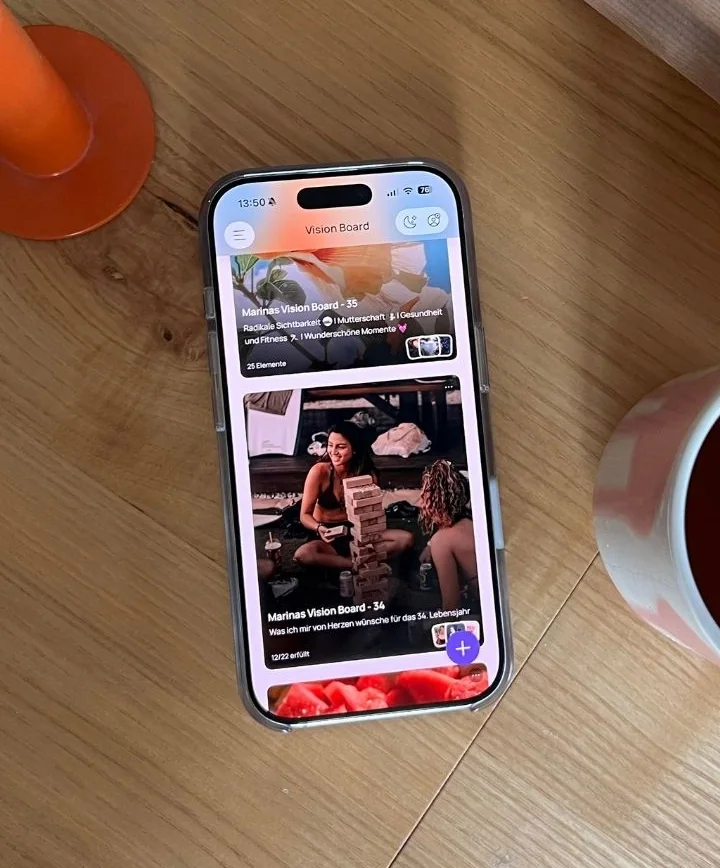
I make a new board every year around my birthday, one per year of my life, instead of on January 1 with everyone's resolutions.
Each year gets a motto: a color, a song or a sentence. One year it was "Pink," the next "Radical visibility."
On last year's board, "Marinas Vision Board – 34," 12 of 22 wishes are marked fulfilled. About half came true.
The universe never delivered; I did. The board kept the goals in view and held me to them.
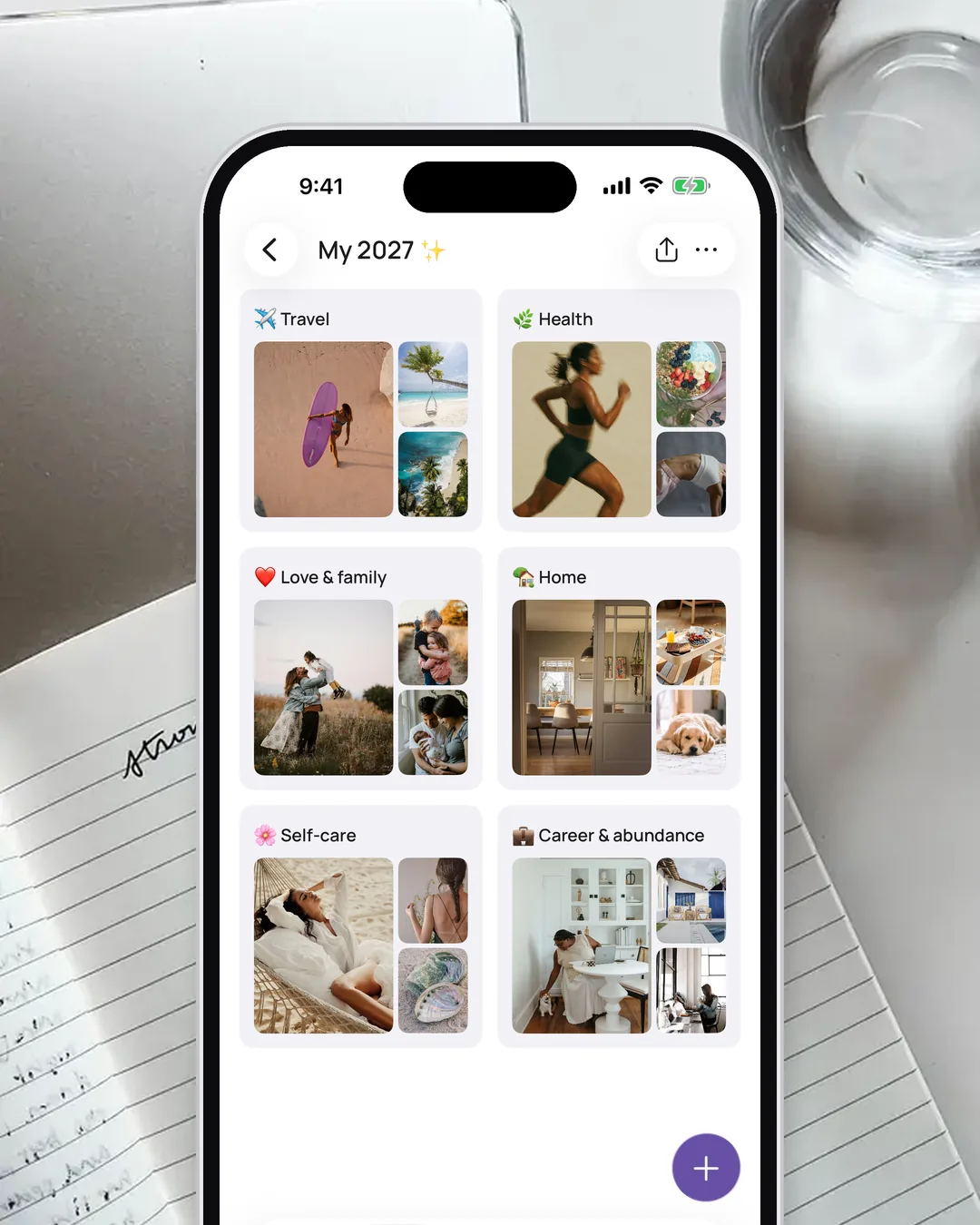
In VISIYA, one board is free for good: your own, or one of the six free templates. The app is for iPhone and iPad; here's how to make a vision board on your phone. The whole method is in how to make a vision board.

 Scan to download VISIYA on the App Store
Frequently asked questions
What goals should I put on a vision board?
Goals from the three or four life areas where you most want something to change this year. A good board goal is specific, has a date and says what you want, not what you want to stop. Give each one a picture and a short line about how it will feel when you get there.
What are the categories of a vision board?
Our Wheel of Balance Board uses eight life areas: Health, Finances, Business and career, Family and friends, Love and relationships, Personal growth, Fun and recreation, and Spirituality. You can add home or community if they matter to you, and you can leave out any area you don't want to work on right now.
How many goals should be on a vision board?
Up to three per area. With three or four areas, that's nine to twelve goals at most, which is about as many as you can keep in view. A short seasonal list, like one for the summer, works well with as few as six.
Do I need to include every life area?
No. Score each area from 1 to 10 first, then pick the three or four with the lowest scores. You can add the others whenever you're ready.
How do I write a goal for a vision board?
Make it specific, give it a date and phrase it as what you want. "I need to stop wasting money" becomes "By March 31, I have $1,000 in my emergency fund." Then add how you want to feel once it's done, and use that as your affirmation.
Is the Wheel of Balance Board free?
Yes. It's one of the six free templates in the VISIYA app, and one board is free for good. The printable version is a free PDF, and you don't need to give an email address to download it.